What It Does
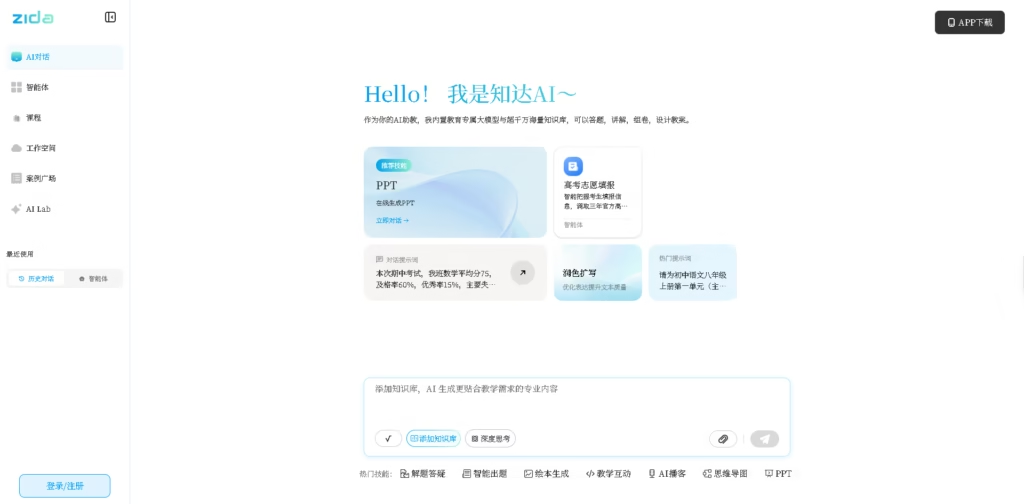
Zida AI is an education-focused AI assistant designed around teaching and learning workflows rather than general-purpose chat. Its interface combines AI conversations, AI agents, courses, workspaces, shared cases, and an AI Lab, with tools for answering questions, explaining concepts, generating tests, and creating lesson plans.
The platform is particularly suited to Chinese-language education workflows where teachers need help turning teaching requirements into usable materials. For example, a teacher could provide a class’s exam performance and main weaknesses, then use an AI agent to draft a detailed exam-quality analysis and improvement plan.
At a Glance
| Field | Details |
|---|---|
| Category | Education AI / AI teaching assistant |
| Primary Users | Teachers, students, and education users |
| Core Approach | Education-specific AI assistant and knowledge base |
| Main Modules | AI Chat, Agents, Courses, Workspace, Case Library, AI Lab |
| Teaching Tasks | Q&A, explanations, test generation, lesson-plan design |
| Content Tools | PPT generation, mind maps, AI podcasts, picture-book generation |
| Knowledge Base | Supports adding knowledge bases for more context-specific content |
The vendor describes Zida AI as an education-specific assistant with a large teaching knowledge base. Independent listings also describe it as covering teaching, learning, practice, assessment, and research workflows, although specific limits and implementation details should be checked directly before purchase.
Key Features
- Education-focused AI answers and step-by-step concept explanations
- AI agents for reusable, task-specific teaching workflows
- Automated question and examination paper generation
- Lesson-plan generation based on teaching requirements
- Online PPT generation for classroom materials
- Knowledge-base support for more tailored educational content
- AI Lab tools including mind maps, podcasts, and interactive teaching functions
Best For
- Generating lesson plans from curriculum goals and teaching requirements
- Creating practice questions and exam papers around specific knowledge points
- Explaining difficult concepts for students during self-study
- Turning classroom performance data into teaching analysis reports
- Building reusable AI-assisted workflows for recurring teaching tasks
Pros & Cons
| Pros | Cons |
| Built specifically around education workflows | Less suitable as a general-purpose AI productivity platform |
| Combines teaching tools with reusable AI agents | Public information does not clearly establish its full integration ecosystem |
| Supports knowledge bases for more contextual outputs | Output accuracy still requires teacher review |
| Covers both teacher- and student-oriented tasks | Detailed pricing and usage limits are not consistently documented publicly |
| Broad collection of teaching-oriented AI functions | Its strongest fit appears to be Chinese education contexts |
Alternatives & Comparisons
| Alternative | Best For | Key Difference |
| MagicSchool | Broad K-12 teacher workflows | Larger dedicated collection of teacher and student tools |
| SchoolAI | Teacher-guided AI learning experiences | Stronger emphasis on student interaction and real-time teacher visibility |
| Khanmigo | AI tutoring and guided learning | More focused on tutoring and learning assistance than teaching-workflow generation |
MagicSchool currently offers 80+ teacher tools and 50+ student tools, while SchoolAI emphasizes teacher-designed Spaces, student AI support, and progress visibility.
Choose Zida AI when an education-specific Chinese workflow combining content generation, agents, knowledge bases, and teaching utilities is more important than a mature international integration ecosystem.
Frequently Asked Questions
Is Zida AI mainly for teachers or students?
It supports both, but the available tools indicate a particularly strong emphasis on teacher workflows such as lesson planning, assessment creation, and instructional content generation.
Can Zida AI generate teaching materials?
Yes. The supplied product interface lists PPT generation, lesson-plan design, question generation, mind maps, AI podcasts, and other educational content tools.
Can teachers add their own knowledge?
The platform provides a knowledge-base function intended to make generated content more aligned with supplied teaching materials and requirements.
Is Zida AI better than a general AI chatbot for teaching?
For structured education workflows, it can be more convenient because its interface groups teaching-specific functions together. A general AI chatbot may still be preferable for broader research, coding, or non-educational tasks.
Does Zida AI replace teacher review?
No AI-generated lesson plans, questions, explanations, or reports should be treated as automatically authoritative. Teachers should verify factual accuracy, curriculum alignment, difficulty, and appropriateness before classroom use.
Overall Rating
| Category | Score |
| Performance | 8.0/10 |
| Ease of Use | 8.3/10 |
| Feature Set | 8.7/10 |
| Workflow Fit | 9.0/10 |
| Overall | 8.5/10 |
Zida AI earns a strong overall score for bringing multiple education-specific AI workflows into one platform, with its biggest uncertainty being the depth of integrations and limits outside its core ecosystem.
Final Verdict
- Best for: Teachers who want one platform for lesson planning, assessment generation, explanations, and teaching content.
- Avoid if: You need extensive international integrations, developer APIs, or a general-purpose AI workspace.
- Biggest strength: Its education-first workflow combines AI assistance, agents, knowledge bases, and teaching utilities.
- Best alternative: MagicSchool for a broader mature K-12 teacher-tool ecosystem.