What It Does
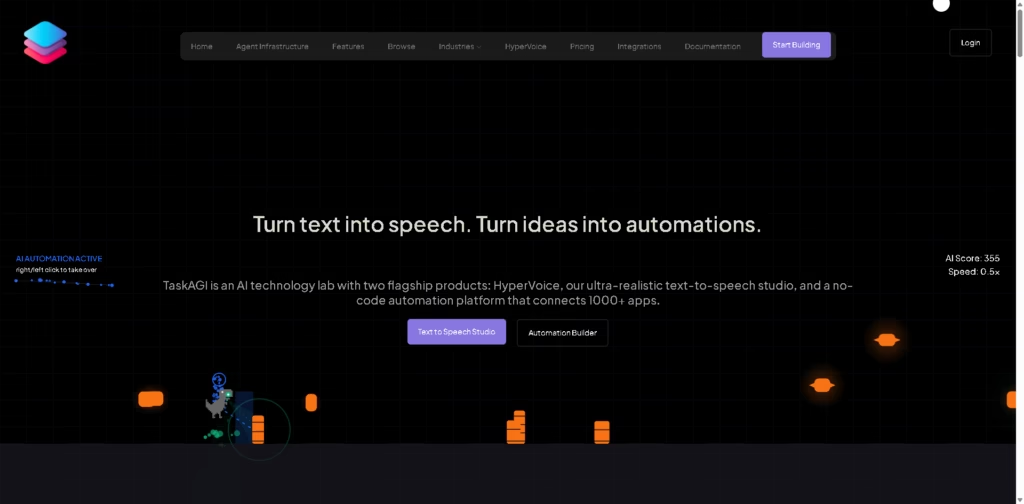
TaskAGI is an AI automation platform built around no-code agent workflows. It combines AI agents, browser automation, reusable templates, and connections to external services so users can automate multi-step tasks without building integrations from scratch.
Its main use case is turning a natural-language objective into an executable workflow. For example, a sales workflow could research prospects, verify email addresses, and add qualified leads to a CRM using connected services such as Apollo, Hunter.io, and HubSpot.
At a Glance
| Field | Details |
|---|---|
| Category | AI agents and no-code automation |
| Primary Use | Multi-step business workflow automation |
| Integrations | 1,000+ claimed integrations |
| Agent Templates | 2,500+ claimed templates |
| Browser Automation | Yes |
| AI Models | OpenAI and Anthropic integrations |
| Pricing | Lifetime plans listed from $49 one-time |
| HyperVoice | Text-to-speech product with monthly allowances on listed lifetime plans |
Key Features
- Build AI agent workflows with a visual, drag-and-drop interface.
- Automate websites when a conventional API or integration is unavailable.
- Deploy reusable AI agent templates for sales, marketing, SEO, and operations.
- Connect workflows to services including OpenAI, Anthropic, WordPress, and Google Sheets.
- Test agent execution and monitor workflows during deployment.
- Use natural-language instructions to define agent objectives and actions.
- Create workflows involving data extraction, enrichment, communication, and CRM updates.
Best For
- Automating repetitive lead research and qualification workflows.
- Connecting multiple business applications into one AI-driven process.
- Extracting information from websites without a dedicated API.
- Deploying prebuilt agents for marketing, sales, SEO, and operations.
- Building multi-step automations without manually coding every API connection.
Pros & Cons
| Pros | Cons |
|---|---|
| No-code approach lowers the technical barrier to agent workflows. | The breadth of integrations can make platform selection and workflow design complex. |
| Browser automation covers websites without suitable integrations. | Listed integration counts and template counts are vendor claims rather than independently verified figures. |
| A large template library can reduce setup time for common workflows. | The supplied information does not establish detailed limits, reliability, or execution performance for every integration. |
| Supports both OpenAI and Anthropic integrations. | Users needing highly specialized, deterministic automation may prefer conventional workflow tools or custom development. |
| Lifetime plans provide an alternative to recurring subscription pricing. | The lifetime offer shown is subject to an advertised limited-time availability. |
Alternatives & Comparisons
| Alternative | Best For | Key Difference |
|---|---|---|
| Zapier | Mainstream app-to-app automation | More established focus on conventional workflow automation and app integrations. |
| Make | Visual, complex automation | Provides granular visual workflow construction and branching logic. |
| n8n | Technical and self-hosted automation | Offers greater control for technical users and self-hosting scenarios. |
| Lindy | AI-agent workflows | Focuses heavily on configurable AI assistants and agent-style automation. |
TaskAGI sits between traditional no-code automation and newer AI-agent platforms, with browser automation adding another execution option. Choose it when natural-language agents, browser tasks, and prebuilt templates are more important than maximum control over conventional workflows.
Frequently Asked Questions
Is TaskAGI a traditional automation platform or an AI-agent platform?
It combines both approaches. Users can build visual workflows while also creating AI agents that determine which connected tools and APIs to use.
Does TaskAGI support browser automation?
Yes. Its browser automation feature is designed for navigating pages, filling forms, extracting information, and interacting with websites when an integration or API is unavailable.
Can TaskAGI connect to OpenAI and Anthropic?
Yes. The supplied integration list includes both OpenAI and Anthropic, allowing workflows to use their respective AI services.
Is TaskAGI suitable for complex multi-step workflows?
It is designed for multi-step agentic workflows involving several tools and services. However, the supplied information does not provide enough evidence to assess reliability or execution limits across particularly complex workflows.
Does TaskAGI offer lifetime pricing?
Yes. The supplied pricing information lists a $49 Lifetime Lite plan and a $99 Lifetime plan, with different agent, AI-credit, and HyperVoice allowances.
Overall Rating
| Category | Score |
|---|---|
| Performance | 8.0/10 |
| Ease of Use | 8.5/10 |
| Feature Set | 9.0/10 |
| Workflow Fit | 8.7/10 |
| Overall | 8.5/10 |
TaskAGI is a strong option for users who want AI-driven, no-code automation with browser capabilities, although real-world reliability should be evaluated for critical workflows.
Final Verdict
- Best for: AI-driven business automation combining agents, integrations, templates, and browser interactions.
- Avoid if you need deeply deterministic workflows or maximum infrastructure-level control.
- Biggest strength: Combines AI agents, browser automation, and a broad integration ecosystem in one platform.
- Best alternative: Choose n8n for greater technical control and self-hosting flexibility.