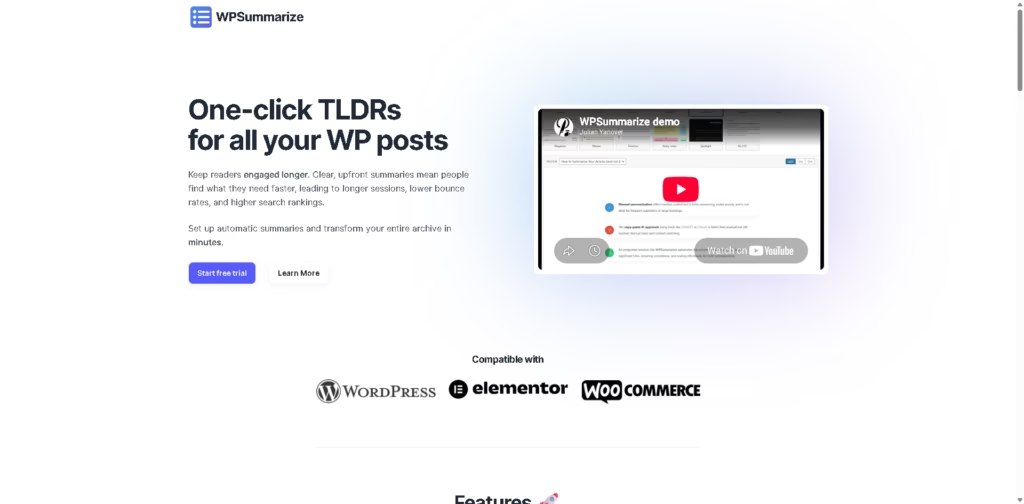
What It Does
WPSummarize is a WordPress plugin that generates AI-powered summaries for posts and displays them as concise TLDR sections. It is designed for publishers who want to add summaries across existing and new content without building a separate summarization workflow.
The plugin supports batch processing, per-post editing, custom post types, and major WordPress editors. A typical workflow is to connect an AI provider through your own API key, generate summaries for an existing archive, review or edit them, and display the chosen summary style on individual posts.
At a Glance
| Field | Details |
|---|---|
| Category | AI WordPress summarization plugin |
| Platform | WordPress |
| AI Model Access | OpenAI, Gemini, Anthropic, xAI |
| API Model | Bring Your Own API Key (BYOK) |
| WordPress Compatibility | Gutenberg, Elementor, Divi |
| Free Plan | 50 summaries/month |
| Pro Pricing | $49/year for 1 site |
| Primary Strength | Automated, customizable post summaries |
Key Features
- Batch-generates summaries for existing WordPress posts.
- Automatically summarizes new articles.
- Supports custom post types alongside standard posts.
- Offers list and narrative summary formats.
- Provides multiple pre-built designs and custom CSS.
- Stores generated summaries as post metadata.
- Allows manual editing, regeneration, and deletion of summaries.
Best For
- Adding TLDR sections across a large WordPress content archive.
- Giving readers quick takeaways before reading full articles.
- Generating summaries for custom WordPress content types.
- Customizing summary layouts without developing a separate system.
- Automating summaries while controlling AI API usage through BYOK.
Pros & Cons
| Pros | Cons |
|---|---|
| Batch processing can save considerable manual work. | Requires users to supply and pay for their own AI API usage. |
| Works with Gutenberg, Elementor, and Divi. | Primarily useful for WordPress websites rather than standalone workflows. |
| Supports custom post types and customizable presentation. | Free version is limited to 50 summaries per month. |
| Summaries can be manually edited and regenerated. | Pro pricing does not include the underlying AI API costs. |
| Supports several major AI providers through BYOK. | The supplied information provides limited detail about summary-quality controls. |
Alternatives & Comparisons
| Alternative | Best For | Key Difference |
|---|---|---|
| AI Engine | Adding broader AI functionality to WordPress | Covers multiple AI features beyond post summarization. |
| Bertha AI | AI-assisted WordPress content creation | Focuses more broadly on generating and optimizing website content. |
| GetGenie AI | WordPress SEO and AI content workflows | Combines content generation with SEO-focused features. |
| AI Power | General-purpose AI tools inside WordPress | Provides a broader collection of AI capabilities rather than specializing in summaries. |
WPSummarize occupies a focused niche: automated AI summaries specifically for WordPress content. Choose it when post-level TLDR generation and presentation are the priority rather than a broad AI content suite.
Frequently Asked Questions
Does WPSummarize include AI usage in its subscription price?
No. The plugin uses a BYOK model, so AI providers charge users separately according to their API usage.
Which AI providers can WPSummarize use?
The supplied information lists OpenAI, Gemini, Anthropic, and xAI, with Azure API keys also mentioned during setup.
Can WPSummarize summarize existing WordPress posts?
Yes. Its batch-processing feature is designed to generate summaries across existing posts.
Does it work with Elementor and Divi?
Yes. The vendor specifically lists Gutenberg, Elementor, and Divi compatibility.
Is WPSummarize suitable for custom post types?
Yes. Custom post types are supported on both the free and Pro feature lists.
Overall Rating
| Category | Score |
|---|---|
| Performance | 8.5/10 |
| Ease of Use | 8.5/10 |
| Feature Set | 8.7/10 |
| Workflow Fit | 9.1/10 |
| Overall | 8.7/10 |
WPSummarize is a strong fit for WordPress publishers needing focused, customizable AI summaries, with BYOK being its main operational trade-off.
Final Verdict
- Best for: WordPress publishers automating customizable TLDR summaries across existing and new content.
- Avoid if: You need a standalone summarizer or broader AI content-generation platform.
- Biggest strength: Combines batch summarization, WordPress compatibility, customization, and BYOK flexibility.
- Best alternative: AI Engine for WordPress users who need broader AI capabilities beyond summarization.