What It Does
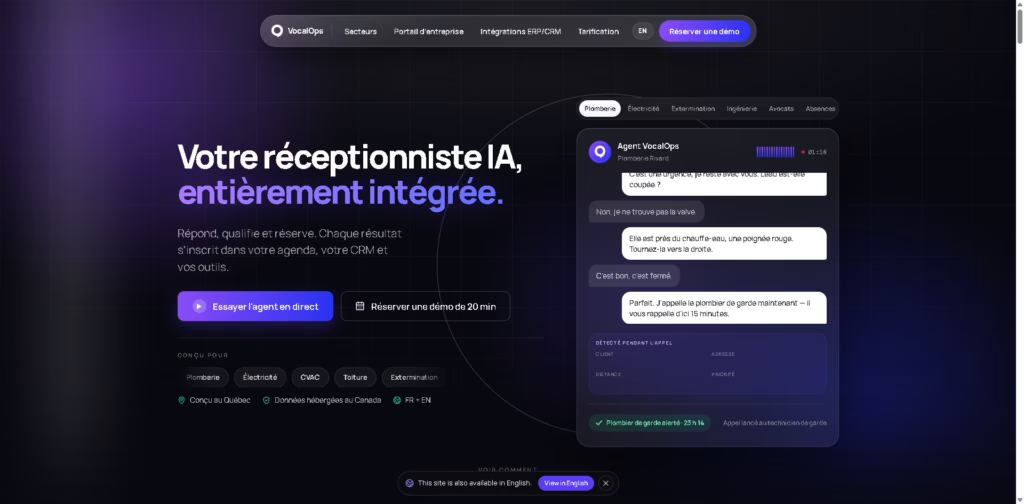
VocalOps is an AI receptionist and voice agent platform designed for businesses that need automated phone coverage. It answers and qualifies calls, books appointments, handles routine customer requests, transfers calls to staff, and connects call information with ERP, CRM, and scheduling systems.
A typical workflow starts when a customer calls the business number. VocalOps identifies the caller and their request, retrieves available customer context from connected systems, determines whether the call is urgent, schedules an appointment or transfers the caller when needed, then sends the summary, transcript, request, and CRM information to the business portal.
Quick Verdict
- Best for: Canadian businesses automating customer phone calls
- Skip if: You need a simple chatbot instead of voice automation
- Key Advantage: Bilingual voice agents with ERP and CRM integration
- Top Alternative: Smith.ai
At a Glance
| Feature | Details |
|---|---|
| Category | AI Voice Agent / Virtual Receptionist |
| Pricing Model | Paid |
| Free Tier | Not specified |
| Platform | Phone, Web Portal, ERP/CRM Integrations |
| API | Custom API available |
| Primary Strength | Integrated bilingual call automation |
| Starting Price | $400 CAD/month |
Pricing & Plans
- Essential: $400 CAD/month. Includes bilingual 24/7 answering, summaries, transcripts, sentiment analysis, business portal, dashboard, live transfers, and emergency alerts.
- Connected: $500 CAD/month. Adds bidirectional ERP/CRM synchronization, caller recognition, customer context, direct appointment booking, automations, and follow-ups.
- Custom: Custom pricing. Includes custom workflows and APIs, multi-site and multi-team routing, white-label reporting, and a dedicated integration engineer.
Usage, telephony, integrations, taxes, and other commercial terms are confirmed in the written proposal.
Note: Prices and plan limits may change. Check the official website for current pricing.
Key Features
- Handles inbound calls continuously with simultaneous calls and no waiting.
- Supports French and English voice interactions with customized vocabulary and routing rules.
- Synchronizes customer information between ERP, CRM, calendars, and VocalOps.
- Retrieves customer history, equipment, warranties, and open invoices during calls.
- Books appointments directly into connected business schedules.
- Provides transcripts, summaries, sentiment data, and call activity through an online portal.
Best For
- Service businesses: Handle customer calls, qualify requests, and identify emergencies automatically.
- Appointment-based businesses: Turn qualified calls into bookings in connected calendars.
- Canadian businesses: Provide automated French and English phone support.
- Field-service teams: Retrieve customer context and route urgent requests to available staff.
- Multi-location organizations: Use custom routing across multiple sites and teams.
Pros & Cons
Pros
- Bilingual French and English support is configured for the business.
- Integrates bidirectionally with ERP, CRM, and scheduling systems.
- Supports direct appointment booking and customer-context retrieval.
- Provides a business portal with transcripts, summaries, requests, and analytics.
- Canadian data hosting is provided as part of its stated deployment approach.
Cons
- Starting price is relatively high for small businesses.
- Exact usage and telephony costs are not included in the published monthly prices.
- Custom integrations and multi-site workflows require the custom plan.
- The supplied information does not specify an API for the lower-priced plans.
Alternatives & Comparisons
| Alternative | Best For | Key Difference vs. VocalOps |
|---|---|---|
| Smith.ai | AI and human virtual reception | Broader receptionist and customer communication services |
| Goodcall | Small-business AI phone answering | More focused on AI phone reception for smaller businesses |
| Retell AI | Developer-focused voice agents | Provides more flexible infrastructure for building custom voice agents |
VocalOps is positioned around managed, business-specific phone automation with ERP, CRM, calendar, and Canadian operational requirements. Businesses should compare integration depth, customization, call volume, and total telephony costs when evaluating alternatives.
FAQs
What is VocalOps used for?
VocalOps is used to automate business phone calls, including reception, customer service, appointment booking, lead qualification, emergency routing, and follow-ups.
Does VocalOps support French and English?
Yes. VocalOps provides bilingual French and English call handling and allows businesses to configure vocabulary, greetings, and transfer rules.
Can VocalOps book appointments?
Yes. The Connected plan includes direct appointment booking through synchronization with the business’s scheduling system.
Which ERP and CRM systems does VocalOps support?
The supplied information lists Acumatica, QuickBooks, Sage, Jobber, ServiceTitan, and custom APIs as integration options.
Does VocalOps store data in Canada?
VocalOps states that its service data is hosted in Canada. It also says the exact locations of applicable components and integrations are confirmed during security review.
ToolsPedia Rating
- Performance & Speed: 4.3/5.0
- Ease of Setup: 4.1/5.0
- Feature Depth: 4.5/5.0
- Value for Price: 4.0/5.0
- ToolsPedia Score: 4.3/5.0
Ratings are based on the documented capabilities and pricing information provided, not hands-on testing.
Final Thoughts
VocalOps focuses on business phone automation with deeper operational integration than a basic AI receptionist. Its combination of bilingual calling, appointment booking, customer context, ERP/CRM synchronization, live transfers, and call analytics makes it suited to businesses where phone interactions are closely tied to daily operations.
Before choosing a plan, businesses should confirm expected call volume, telephony charges, required integrations, data-handling requirements, and whether the Essential or Connected level provides the necessary workflow automation.