What It Does
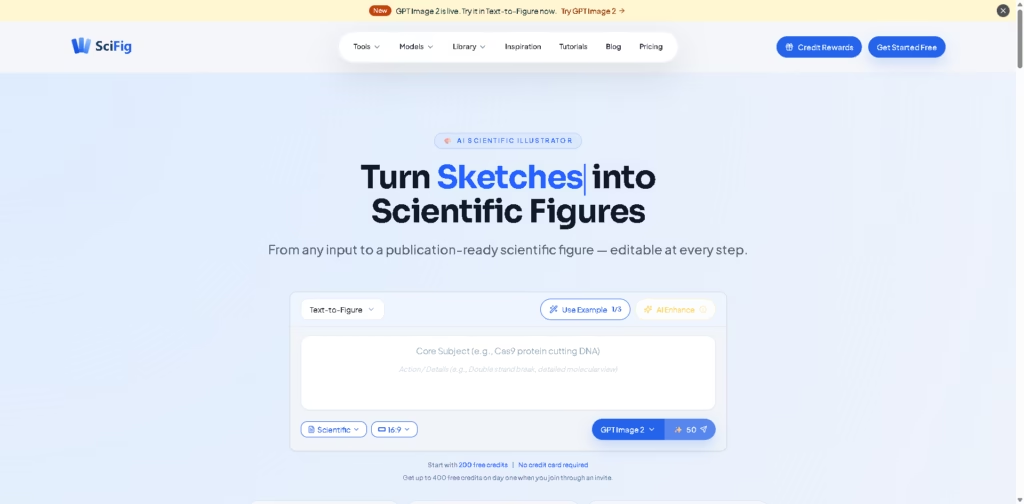
SciFig is an AI-powered scientific illustration platform that helps researchers turn text, sketches, reference images, PDFs, and lab photos into publication-ready scientific figures.
Unlike many AI image generators, SciFig focuses on creating editable scientific visuals that can be refined and exported for journals, presentations, and academic publications.
Key Features
- Multiple input methods – Generate figures from text, sketches, reference images, PDFs, lab photos, or a built-in vector canvas.
- AI-powered figure generation – Creates publication-ready scientific illustrations in seconds.
- Six publication styles – Choose from Scientific, Line, 3D, Editorial, Sketch, Watercolor, or let Auto mode decide.
- Editable text – Modify labels, fonts, sizes, and positions after generation without recreating the figure.
- Region-based editing – Regenerate only selected parts of an illustration using natural language prompts.
- PDF-assisted enhancement – Upload PDFs to provide context for smarter figure refinements.
- Multimodal enhancement – Improve figures using text prompts, references, and additional visual inputs.
- 8K upscaling – Export high-resolution images suitable for publications and presentations.
- Editable exports – Download figures as PPTX, layered SVG, PNG, or JPG for further editing.
- Built-in vector canvas – Edit shapes, labels, and colors directly inside SciFig with undo and redo support.
- Specialized scientific tools include generators for PRISMA flow diagrams, graphical abstracts, conceptual frameworks, bell curves, free body diagrams, syntactic trees, and more.
- Free credits for new users – Start with free credits without requiring a credit card.
Who Is SciFig For?
- Researchers – Create publication-ready figures for journal articles and conference papers.
- Graduate students – Produce clear scientific diagrams for theses, dissertations, and coursework.
- University professors – Design lecture materials, textbooks, and research presentations.
- Laboratories – Standardize scientific figures across multiple research projects.
- Science communicators – Create engaging visuals for educational content and public outreach.
- Medical and life science professionals – Illustrate biological pathways, molecular mechanisms, and clinical concepts.
- Engineering, chemistry, and physics researchers – Develop technical diagrams beyond biology.
- Grant writers – Turn complex research proposals into clear visual summaries.
Final Thoughts
SciFig stands out by focusing specifically on scientific illustration rather than general AI image generation. Its support for multiple input methods, editable labels, selective regeneration, and vector exports makes it particularly useful for researchers who frequently revise figures during peer review or collaboration.
The ability to export editable PPTX and layered SVG files eliminates much of the manual work typically required in design software, while built-in editing tools help keep revisions efficient.
If you regularly create scientific figures for papers, presentations, grants, or teaching materials, SciFig is a compelling option to streamline your workflow.
Try the free credits first to see whether its AI-generated figures fit your research needs.