What It Does
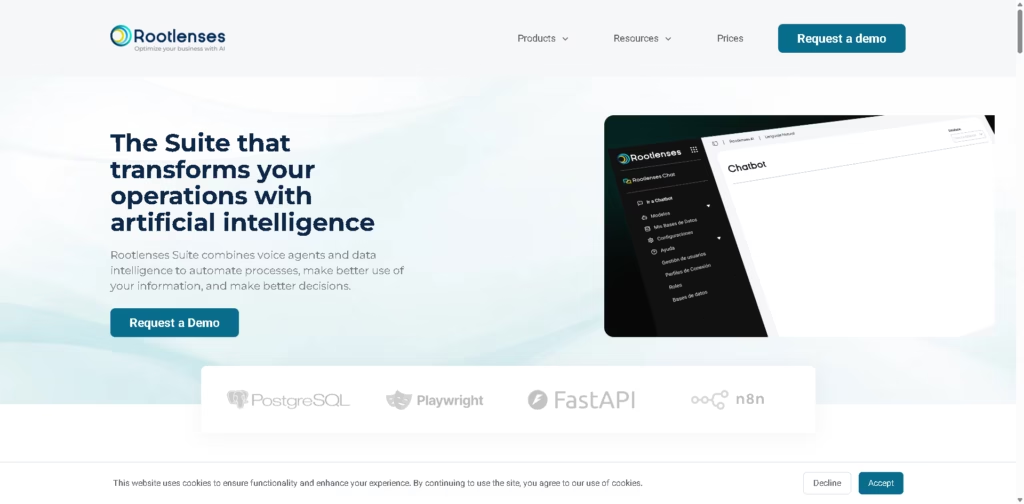
Rootlenses is an AI operations suite that combines AI voice agents, natural-language business data access, and AI integration governance. Its three main products are Rootlenses Voice for automating phone-based workflows, Rootlenses Insight for querying business databases without manual SQL, and Rootlenses MCP for connecting AI models with enterprise applications and controlling access.
For example, a business can use Voice to answer calls, qualify leads, schedule appointments, collect payments, or manage routine inquiries, while Insight lets teams ask questions about connected business databases in natural language. MCP adds a control layer for managing how AI models interact with enterprise systems.
Quick Verdict
- Best for: Businesses combining AI voice automation with data intelligence
- Skip if: You only need a standalone voice agent or analytics tool
- Key Advantage: Combines voice, data, and AI governance
- Top Alternative: Microsoft Power Platform
At a Glance
| Feature | Details |
|---|---|
| Category | AI Operations Suite |
| Pricing Model | Paid |
| Free Tier | Not specified |
| Platform | Web, AI integrations |
| API | Not specified |
| Primary Strength | Integrated AI operations |
| Starting Price | $29/month |
Pricing & Plans
Rootlenses lists separate pricing tiers under Insight and Voice, with the supplied pricing page showing the following plans:
- Starter: $29/month, 3 users, 1 database connection, basic email support, standard security, standard reports
- Business: $89/month, 10 users, up to 3 database connections, priority email and chat support, advanced security, standard reports
- Professional: $169/month, unlimited users, up to 10 database connections, premium 24/7 phone support, dedicated account manager, full security suite, advanced analytics and reporting, and custom AI model fine-tuning
- Custom plans: Available through the sales team for organizations needing customized options
The pricing information provided does not clearly identify which listed tiers apply specifically to Insight versus Voice, although the page labels the products separately.
Note: Prices and plan limits may change. Check the official website for current pricing.
Key Features
- AI voice agents answer calls, qualify leads, schedule appointments, and handle routine inquiries.
- Insight lets users query business data using natural language instead of manual SQL.
- MCP connects AI models with enterprise applications, databases, and business tools.
- Voice agents can automate payments, follow-ups, collections, and appointment confirmations.
- Insight supports connections to multiple databases and business reporting.
- MCP provides access, permission, and execution controls for AI integrations.
Best For
- Customer service teams: Automate repetitive inbound calls and routine inquiries.
- Sales teams: Qualify leads and manage appointment-related calls through AI voice agents.
- Operations teams: Query business databases without manually writing SQL.
- Financial teams: Automate collection and payment-related voice workflows.
- Enterprise IT teams: Control AI access to internal applications and databases.
Pros & Cons
Pros
- Combines voice automation, data intelligence, and AI governance in one suite.
- Supports multiple database connections on higher Insight plans.
- Voice agents cover calls, lead qualification, scheduling, payments, and follow-ups.
- MCP provides controls for AI access and execution within enterprise environments.
- Professional pricing includes advanced analytics, reporting, and custom AI model fine-tuning.
Cons
- Public pricing details do not clearly separate Voice and Insight plans.
- API availability is not specified in the supplied information.
- No free tier or free trial is specified.
- Many enterprise-oriented capabilities require higher-priced plans or customized sales engagement.
Alternatives & Comparisons
| Alternative | Best For | Key Difference vs. Rootlenses |
|---|---|---|
| Microsoft Power Platform | Business automation and data workflows | Broader Microsoft ecosystem and low-code tooling |
| UiPath | Enterprise process automation | More focused on robotic process automation |
| Genesys Cloud CX | Contact center automation | More focused on customer service and contact-center operations |
Rootlenses fits organizations looking for a combined approach to AI voice automation, business data access, and AI integration control. A specialized alternative may be more suitable when the primary requirement is contact-center management, robotic process automation, or a broader low-code ecosystem.
FAQs
What is Rootlenses used for?
Rootlenses is used for AI-powered voice automation, business data intelligence, and controlled AI integrations with enterprise systems.
Can Rootlenses automate phone calls?
Yes. Rootlenses Voice can answer calls, qualify leads, schedule appointments, collect payments, follow up with customers, and handle routine inquiries.
Does Rootlenses require SQL knowledge?
Rootlenses Insight is designed to let users query business data using natural language, reducing the need for manual SQL queries.
How many databases can Rootlenses connect to?
The listed Insight plans provide one database connection on Starter, up to three on Business, and up to ten on Professional.
Does Rootlenses offer AI governance?
Yes. Rootlenses MCP provides a control layer for connecting AI models with applications, databases, and business tools while managing access, permissions, and execution.
ToolsPedia Rating
- Performance & Speed: 4.1/5.0
- Ease of Setup: 4.0/5.0
- Feature Depth: 4.5/5.0
- Value for Price: 4.0/5.0
- ToolsPedia Score: 4.2/5.0
Ratings are based on the documented capabilities and pricing information provided, not hands-on testing.
Final Thoughts
Rootlenses takes a broader approach than a typical AI voice or business intelligence product by combining voice agents, natural-language data access, and AI integration controls. Its documented use cases cover customer calls, scheduling, payments, collections, reporting, and enterprise data workflows.
Organizations considering it should compare the required Voice and Insight capabilities, database needs, integration requirements, and plan limits before choosing a subscription.