What It Does
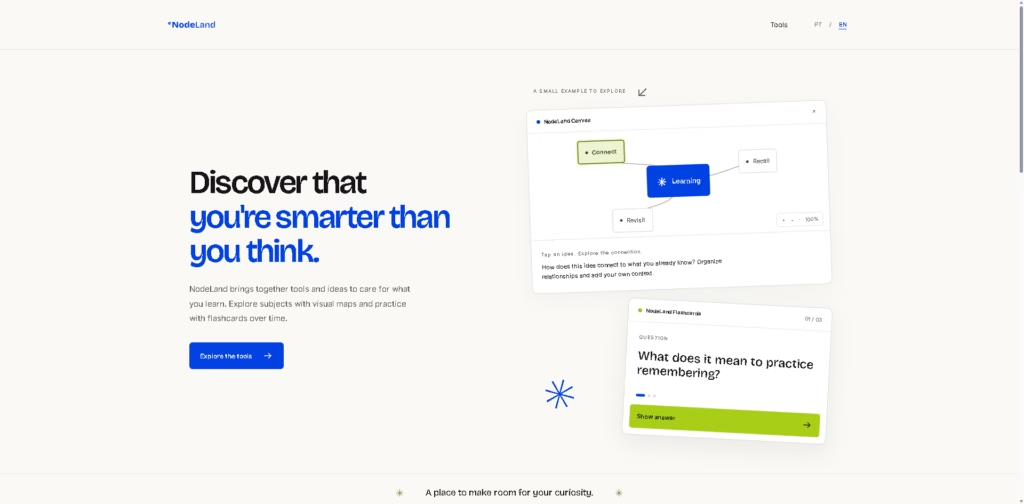
NodeLand is a learning platform that helps users organize ideas visually and strengthen memory through active recall and spaced repetition. It provides two tools: Canvas for connected visual notes and itFlashcards for structured memory practice.
Users can organize notes and relationships in Canvas, then create questions and revisit learning material through Flashcards. The platform is built around connecting ideas, recalling information without looking at notes, and reviewing material at spaced intervals.
Quick Verdict
- Best for: Students and learners who want visual organization and spaced-review tools.
- Skip if: You need advanced AI-powered learning content generation or extensive integrations.
- Key Advantage: Combines visual knowledge mapping with flashcards and spaced repetition.
- Top Alternative: RemNote
At a Glance
| Feature | Details |
|---|---|
| Category | Learning and Knowledge Management |
| Pricing Model | Not specified |
| Free Tier | Not specified |
| Platform | Web |
| API | Not specified |
| Primary Strength | Visual learning and spaced repetition |
| Core Tools | Canvas and Flashcards |
Key Features
- Organizes ideas through visual maps and connected notes.
- Keeps contextual information alongside related ideas.
- Provides flashcards for active recall practice.
- Uses spaced reviews to revisit learning material over time.
- Supports a shared account across Canvas and Flashcards.
Best For
- Students organizing complex subjects visually.
- Learners practicing active recall regularly.
- Users connecting related notes and concepts.
- People building structured study materials.
- Learners who prefer visual knowledge organization.
Pros & Cons
Pros
- Combines visual maps with flashcard-based learning.
- Supports connected notes and contextual organization.
- Uses active recall and spaced repetition principles.
- Provides dedicated Canvas and Flashcards tools.
Cons
- Pricing information is not specified in the provided source.
- API availability is not specified.
- Advanced AI learning features are not described.
Alternatives & Comparisons
| Alternative | Best For | Key Difference vs. NodeLand |
|---|---|---|
| RemNote | Knowledge management and spaced repetition | Combines notes, flashcards, and knowledge management |
| Anki | Custom flashcard-based learning | Primarily focused on customizable flashcard reviews |
| Obsidian | Connected notes and knowledge graphs | More flexible general-purpose knowledge management |
NodeLand focuses specifically on connecting ideas and practicing recall through two dedicated learning tools. It may suit learners who want a simpler combination of visual maps, connected notes, and spaced flashcard reviews.
Frequently Asked Questions
What is NodeLand?
It is a learning platform with visual mapping and flashcard tools designed to support connected learning, active recall, and spaced repetition.
What is Canvas?
Canvas is a visual workspace for organizing notes, exploring relationships, and keeping context close to related ideas.
What are its Flashcards?
Its Flashcards let users create questions, practice retrieving answers, and return to material through spaced reviews.
Does it use spaced repetition?
Yes. It describes spaced repetition as one of the learning practices guiding its product choices.
Does it provide AI-generated learning content?
The provided source does not describe AI-generated flashcards, quizzes, summaries, or other content-generation features.
ToolsPedia Rating
- Performance & Speed: 4.1/5.0
- Ease of Setup: 4.4/5.0
- Feature Depth: 3.8/5.0
- Value for Price: Not rated
- ToolsPedia Score: 4.1/5.0
Editorial assessment based on the published feature set and product information. This rating does not represent hands-on testing. Value for Price is not rated because pricing was not specified in the provided source.
Final Thoughts
NodeLand takes a focused approach to learning by combining visual knowledge organization with active recall and spaced repetition. Its Canvas and Flashcards tools cover two complementary parts of the learning process without presenting a large collection of unrelated features. Users looking for more advanced AI study automation or broader integrations may need a more feature-rich platform.