What It Does
NeuroSpell is a neural auto-correction and language-processing tool designed to automatically correct spelling, punctuation, word-boundary, phonetic, and other writing errors. Unlike a conventional spell checker, it uses deep-learning-based correction and can be adapted to domain-specific vocabulary, sentence structures, phrasing, and machine-generated errors.
The software targets both individual writing assistance and industrial workflows such as proofreading automation, OCR error correction, speech-to-text enhancement, customer-input enrichment, and translation quality checking. It can also be deployed on-premises for environments that require processing within an organization’s intranet.
A typical workflow could involve feeding OCR or speech-to-text output into NeuroSpell, automatically correcting common language errors, and passing the cleaned text to a downstream application.
At a Glance
| Field | Details |
|---|---|
| Category | Neural auto-correction and language processing |
| Technology | Deep learning, neural auto-correction |
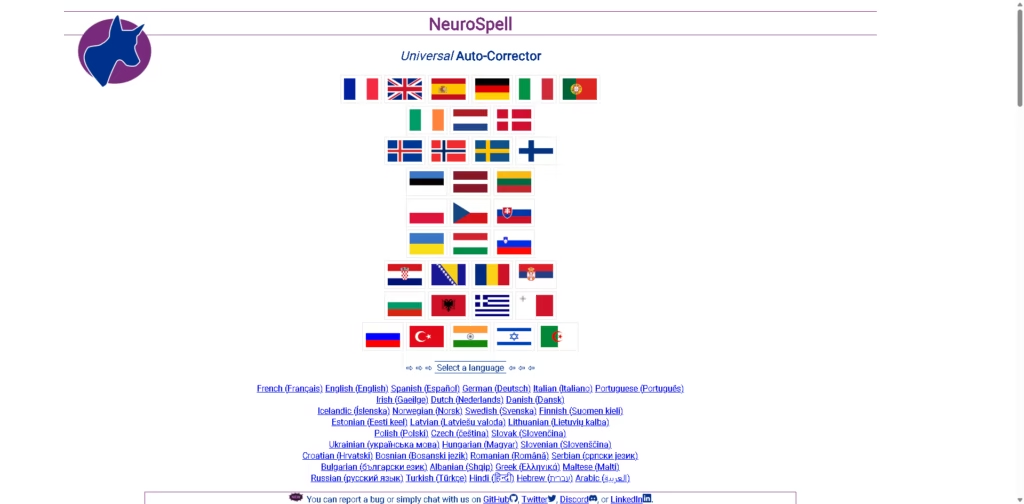
| Languages | 40+ listed languages, with varying capabilities |
| Deployment | On-premise deployment available |
| Customization | Domain-specific vocabulary, phrasing, and machine errors |
| Industrial Uses | OCR correction, speech-to-text enhancement, proofreading RPA |
| Related Product | NeuroBiSpell translation checker and auto-corrector |
Key Features
- Neural correction of spelling, punctuation, phonetic, and word-boundary errors.
- Handles complex language flexions and language-specific confusions.
- Supports correction of non-native writing errors.
- Adapts to domain-specific vocabulary and sentence structures.
- Provides rule-based spelling, grammar, style, and formatting checks for supported languages.
- Supports named-entity recognition for persons, places, acronyms, and related entities.
- Offers on-premises deployment without sending data outside an organization’s intranet.
Best For
- Automatically correcting OCR-generated text before downstream processing.
- Cleaning speech-to-text output containing transcription-related language errors.
- Improving customer-entered text in automated workflows.
- Applying domain-specific correction to specialized terminology.
- Automating proofreading within enterprise text-processing pipelines.
Pros & Cons
| Pros | Cons |
| Goes beyond basic spell checking with neural auto-correction. | Language capabilities vary considerably between supported languages. |
| Can be trained around specialized vocabulary and writing patterns. | The feature matrix is complex and requires language-by-language evaluation. |
| Supports on-premise deployment for intranet-based processing. | Some listed languages have rule-based support without neural auto-correction. |
| Covers OCR, speech-to-text, proofreading, and workflow enrichment. | It is more specialized than general-purpose writing assistants. |
| Partially open-source through OpenNeuroSpell. | The product’s industrial deployment model may require technical integration work. |
Alternatives & Comparisons
| Alternative | Best For | Key Difference |
| LanguageTool | General multilingual grammar and spelling correction | More oriented toward user-facing writing assistance and conventional language checking. |
| NeuSpell | Neural spelling correction research and experimentation | More focused on neural spelling correction as a research-oriented system. |
| GECToR | Grammatical error correction development | Designed around grammatical error correction rather than broader industrial text-processing workflows. |
| Microsoft Editor | Everyday writing assistance | Provides a mainstream user-facing writing environment rather than specialized on-premise correction infrastructure. |
NeuroSpell sits closer to an industrial language-processing component than a typical consumer grammar checker. Choose it when automated correction, domain adaptation, multilingual processing, or on-premise deployment matters more than a polished general-purpose writing interface.
Frequently Asked Questions
Is NeuroSpell a spell checker or an auto-corrector?
It is primarily an auto-correction system. Its neural models can correct multiple error types rather than simply flagging words for manual review.
Can NeuroSpell be customized for specialized terminology?
Yes. The vendor states that NeuroSpell can be trained using domain-specific vocabulary, sentence structures, phrasing, and machine-specific errors.
Does NeuroSpell support on-premise deployment?
Yes. The vendor explicitly describes an on-premise capability that allows deployment without sending data outside an organization’s intranet.
Does every supported language have the same capabilities?
No. The published language matrix shows different corpus sizes and different combinations of neural and rule-based capabilities by language.
Can NeuroSpell work with OCR and speech-to-text output?
Yes. OCR error correction and speech-to-text enhancement are among the industrial applications identified by the vendor.
Overall Rating
| Category | Score |
| Performance | 8.2/10 |
| Ease of Use | 7.0/10 |
| Feature Set | 8.6/10 |
| Workflow Fit | 8.8/10 |
| Overall | 8.3/10 |
NeuroSpell is strongest as a customizable language-processing component for automated correction workflows, especially where deployment and domain adaptation are important.
Final Verdict
- Best for: Enterprise workflows requiring automated, domain-specific multilingual text correction.
- Avoid if: You only need a simple consumer-facing spelling and grammar checker.
- Biggest strength: Neural correction can be adapted to specialized vocabulary, phrasing, and machine-generated errors.
- Best alternative: LanguageTool is more suitable for straightforward everyday multilingual writing assistance.