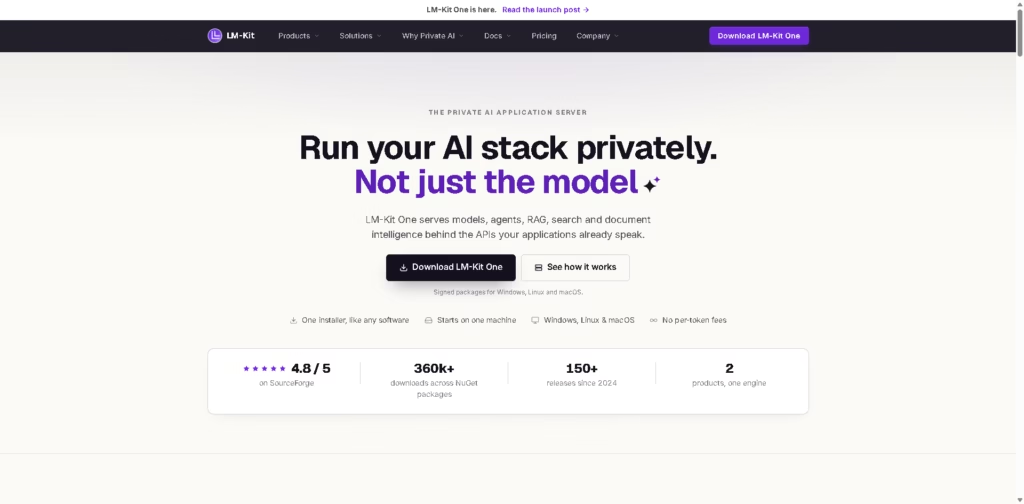
What It Does
LM-Kit is a private AI platform for running AI models, document intelligence, RAG, search, agents, and related processing on infrastructure controlled by the user. It offers two products: LM-Kit One, a private AI application server, and LM-Kit.NET, an embedded AI runtime for .NET applications.
A typical workflow could involve deploying LM-Kit One on a Windows or Linux machine, ingesting company documents, using OCR and document extraction to process them, indexing the content for search, and returning cited answers through an AI application. Existing applications can connect through OpenAI, Anthropic, Ollama, or MCP-compatible interfaces.
Quick Verdict
- Best for: Running private AI, document processing, RAG, and agents on controlled infrastructure
- Skip if: You need a publicly listed fixed price for commercial production use
- Key Advantage: Combines multiple private AI capabilities in one deployment
- Top Alternative: Ollama
At a Glance
| Feature | Details |
|---|---|
| Category | Private AI Platform |
| Pricing Model | Freemium / Custom Licensing |
| Free Tier | Yes |
| Platform | Windows, Linux, macOS |
| API | Yes |
| Primary Strength | Private AI processing on controlled infrastructure |
| Deployment | Self-hosted |
| AI Interfaces | OpenAI, Anthropic, Ollama, MCP |
Pricing & Plans
- Free: $0 with no activation key or expiry. Available for companies under $1 million USD annual gross revenue, 10 or fewer employees, and no more than $3 million USD raised from outside investors.
- Free eligibility: Personal use, education, nonprofits, and open-source projects are always free.
- Evaluation and development: Free at any company size with no time limit.
- Professional: Custom annual pricing. LM-Kit.NET is licensed per application or product family, while LM-Kit One is licensed per deployment.
- Professional support: Includes production and redistribution rights defined in the order, long-term support builds, security patches, and support with response-time commitments.
- Billing structure: Professional licensing is not metered by tokens, developers, seats, or end users.
- Free commercial production: Qualifying companies can use the software commercially, with a visible LM-Kit acknowledgement required on the product website or documentation.
Note: Prices and plan limits may change. Check the official website for current pricing.
Key Features
- Runs AI models locally using CPU, CUDA, Vulkan, or Metal.
- Processes documents with OCR, parsing, extraction, classification, and conversion.
- Provides RAG with vector search, hybrid retrieval, and cited answers.
- Supports AI agents with planning, memory, tools, MCP, and orchestration.
- Provides local vision, multimodal processing, image embeddings, and VLM chat.
- Supports local speech transcription across more than 100 languages.
Best For
- Processing sensitive documents without sending source files to hosted AI services.
- Building private company knowledge search with document and passage citations.
- Deploying AI agents with governed tools and human approval workflows.
- Adding local AI capabilities to .NET software products.
- Running AI workloads in air-gapped or intermittently connected environments.
Pros & Cons
Pros:
- Combines document intelligence, RAG, agents, vision, speech, and local inference.
- Supports multiple AI API dialects and MCP connections.
- Runs on Windows, Linux, and macOS with CPU or supported GPU acceleration.
- Qualifying small companies can use the complete platform at no cost.
Cons:
- Professional production pricing is custom rather than publicly listed.
- Professional licensing is required above the published free-tier thresholds.
- LM-Kit.NET specifically targets .NET application embedding, limiting that product’s relevance to other development ecosystems.
Alternatives & Comparisons
| Alternative | Best For | Key Difference vs. This Tool |
|---|---|---|
| Ollama | Running local language models | Primarily focuses on local model serving rather than a broader AI application stack |
| AnythingLLM | Private document chat and RAG | More focused on knowledge-base and document-chat workflows |
| LocalAI | OpenAI-compatible local AI APIs | Focuses on self-hosted AI inference and API compatibility |
LM-Kit sits across several private AI categories by combining local inference, document intelligence, RAG, agents, vision, speech, and application serving. Choose it when your workflow requires several of these capabilities together, and you want them deployed or embedded within infrastructure you control.
Frequently Asked Questions
Can LM-Kit run AI completely locally?
Yes. In fully local mode, models, documents, OCR, indexes, embeddings, and generated outputs remain inside the controlled infrastructure.
Does LM-Kit support OpenAI-compatible applications?
Yes. LM-Kit One supports OpenAI, Anthropic, and Ollama API dialects, as well as MCP.
Does LM-Kit require a GPU?
No. The vendor states that CPU operation works out of the box, while CUDA, Vulkan, and Metal can be used when available.
What happens if a company exceeds the free-tier thresholds?
Evaluation and development remain free, but production use and redistribution require a Professional License. The vendor states that a company crossing a threshold retains its free grant for 90 days.
Is LM-Kit.NET the same as LM-Kit One?
They use the same underlying technology but serve different deployment models. LM-Kit One is a server for applications and teams, while LM-Kit.NET embeds the runtime into .NET products.
ToolsPedia Rating
- Performance & Speed: 4.0/5.0
- Ease of Setup: 3.8/5.0
- Feature Depth: 4.7/5.0
- Value for Price: 4.2/5.0
- ToolsPedia Score: 4.2/5.0
Final Thoughts
LM-Kit is designed for organizations that need AI processing, document intelligence, knowledge retrieval, and agents without making hosted AI services the center of their data workflow. Its broad capability set and self-hosted architecture make it relevant for developers building private AI applications, especially .NET teams using LM-Kit.NET. Start with the free download if your project qualifies, or request a custom quote if you need production licensing above the published thresholds.