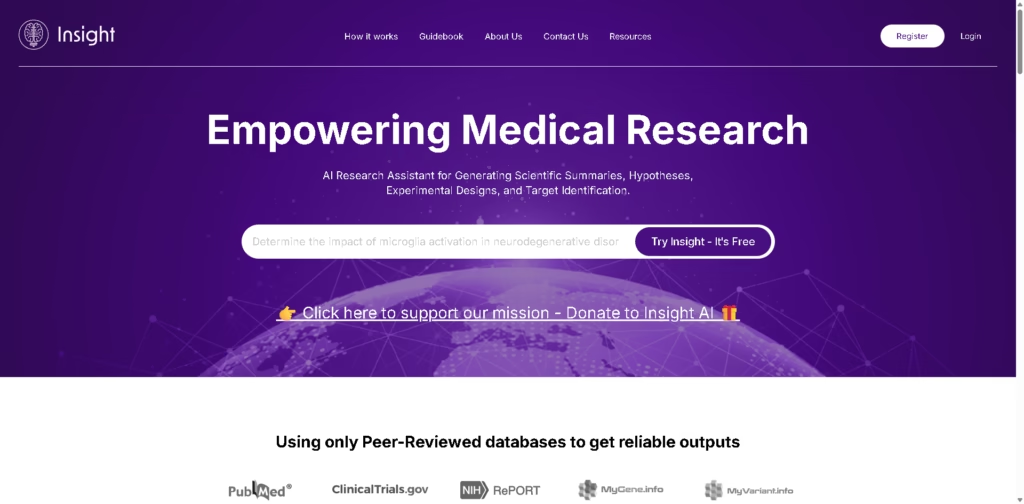
What It Does
Insight AI is a medical research assistant designed to help researchers work with biomedical literature and research data. It can generate scientific summaries, formulate hypotheses, create experimental designs, and provide citations using integrated research databases.
Its workflow combines literature search with research-oriented analysis. For example, a researcher investigating a disease target can search peer-reviewed literature, review generated summaries, explore relevant genes or variants, and use the platform to develop a hypothesis or experimental design.
At a Glance
| Field | Details |
|---|---|
| Category | AI Medical Research Assistant |
| Primary Focus | Biomedical research and literature analysis |
| Literature Database | NIH PubMed |
| Research Databases | NIH Reporter, NIH Clinical Trials |
| Genetic Data | MyGene and MyVariant |
| Key Outputs | Summaries, hypotheses, experimental designs |
| Access | Free trial available |
Key Features
- Generates scientific summaries from biomedical literature.
- Formulates research hypotheses from available scientific information.
- Creates experimental designs for research objectives.
- Provides citations alongside research outputs.
- Searches more than 36 million biomedical articles through PubMed.
- Integrates gene and human-variant databases for deeper research.
- Supports target, biomarker, and prognostic marker discovery.
Best For
- Reviewing large volumes of biomedical literature efficiently.
- Developing hypotheses from existing scientific research.
- Designing experiments around specific research objectives.
- Investigating genes, mutations, and potential therapeutic targets.
- Exploring biomarkers and potential disease-related research directions.
Pros & Cons
| Pros | Cons |
| Integrates several established biomedical research databases | Primarily focused on medical and biomedical research |
| Combines literature search with hypothesis and experiment generation | Discovery features are presented as a waitlist offering |
| Provides citations for generated research outputs | Claimed time-saving percentages are not independently substantiated |
| Covers genes, variants, clinical trials, and research grants | The supplied information provides limited detail about output validation |
| Free access is advertised for trying the research assistant | It should complement, not replace, researcher judgment and literature verification |
Alternatives & Comparisons
| Alternative | Best For | Key Difference |
| Elicit | Literature reviews and evidence synthesis | More broadly focused on research-question-driven literature workflows |
| Consensus | Evidence-based research questions | Focuses on synthesizing findings from scientific papers |
| Scite | Citation analysis and research verification | Emphasizes citation context and how studies are cited |
| PubMed | Biomedical literature search | Provides direct access to biomedical publications without AI-generated research workflows |
Insight AI fits the market as a biomedical-focused research assistant that combines literature access with hypothesis and experimental-design generation. Choose it when biomedical databases, genetics, clinical research, and research ideation need to work together in one workflow.
Frequently Asked Questions
Which research databases does Insight AI use?
The supplied information lists NIH PubMed, NIH Reporter, NIH Clinical Trials, MyGene, and MyVariant.
Can Insight AI generate research hypotheses?
Yes. Hypothesis formulation is one of the platform’s stated core capabilities.
Can Insight AI create experimental designs?
Yes. The platform specifically lists experimental-design generation as a research capability.
Does Insight AI provide citations?
Yes. The vendor describes reliable citations as an integrated feature of its research workflow.
Is Insight AI suitable for genetic research?
It includes MyGene and MyVariant integrations for investigating genes and human genetic variants, making genetic research one of its supported areas.
Overall Rating
| Category | Score |
| Performance | 8.5/10 |
| Ease of Use | 7.5/10 |
| Feature Set | 9.0/10 |
| Workflow Fit | 9.0/10 |
| Overall | 8.5/10 |
Insight AI offers a strong research-oriented feature set for biomedical workflows, although users should independently validate AI-generated hypotheses, designs, and conclusions.
Final Verdict
- Best for: Biomedical researchers needing literature summaries, hypotheses, experimental designs, and research database access.
- Avoid if: You need a general-purpose research assistant outside medical and biomedical topics.
- Biggest strength: Combines biomedical literature, clinical research, genetics, and AI research workflows.
- Best alternative: Elicit for broader literature-review and evidence-synthesis workflows.