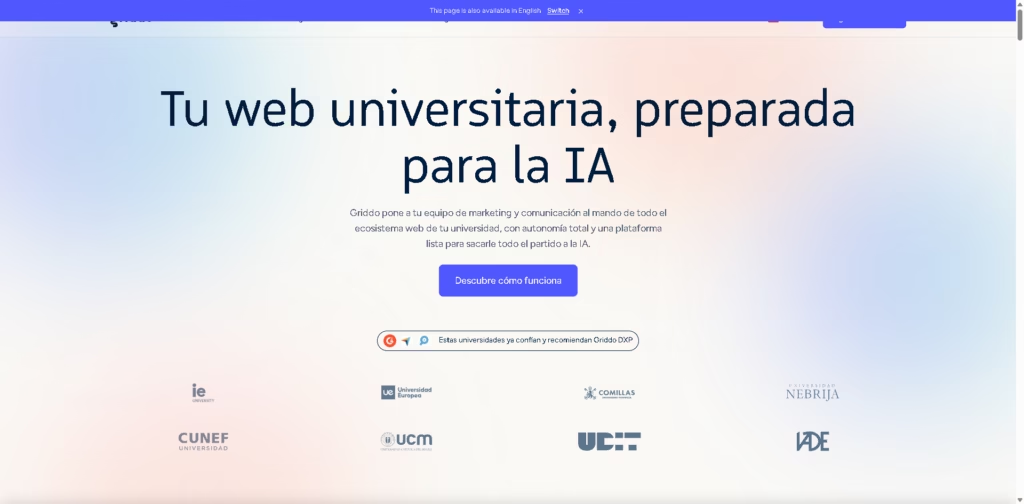
What It Does
Griddo is a digital experience platform (DXP) built for universities and their marketing, communications, and technology teams. It provides a no-code environment for managing multiple websites, creating pages, reusing structured content, maintaining brand consistency, and publishing across an institution’s web ecosystem.
A typical workflow involves creating or editing content through Griddo’s modular builder, reusing structured information across sites, generating SEO metadata and image tags with AI Booster, translating content with DeepL, and publishing responsive pages. Teams can also manage permissions, create forms connected to CRMs, and use integrated tools for SEO, analytics, content, and design workflows.
Quick Verdict
- Best for: Universities managing multiple websites and large digital content ecosystems.
- Skip if: You need a simple website builder for a small standalone website.
- Key Advantage: Combines multi-site content management, no-code editing, AI tools, and institutional governance.
- Top Alternative: WordPress.
At a Glance
| Feature | Details |
|---|---|
| Category | Digital Experience Platform (DXP) |
| Pricing Model | License plans; pricing details not provided |
| Free Tier | Not specified |
| Platform | Web-based DXP |
| API | Integrations supported; specific API details not provided |
| Primary Strength | University-focused multi-site web management |
Pricing & Plans
Griddo provides license plans and a license calculator, but the supplied information does not include specific plan prices or limits.
The platform is positioned for enterprise-level university deployments and offers a demo-based sales process.
Note: Prices and plan limits may change. Check the official website for current pricing.
Key Features
- No-Code Builder: Create and arrange pages without programming.
- Multi-Site Management: Manage an institution’s web ecosystem from one platform.
- Content Reuse: Update structured content once and reuse it across sites.
- AI Booster: Automate image tagging, SEO metadata, summaries, and translations.
- Design System: Maintain consistent branding across sites and components.
- Form Builder: Create forms and connect collected data with CRM systems.
- Role Management: Assign permissions to SEO, analytics, content, and design teams.
- Responsive Design: Build pages that adapt across mobile, tablet, and desktop devices.
Best For
- Universities: Manage large institutional websites and digital content.
- Marketing Teams: Create campaigns and pages without relying entirely on developers.
- Communication Teams: Publish and reuse institutional content efficiently.
- Technology Teams: Manage governance, permissions, integrations, and infrastructure.
- Multi-Site Organizations: Maintain consistent content and branding across multiple sites.
Pros & Cons
Pros
- Designed specifically around university web ecosystems.
- Supports no-code page creation and reusable structured content.
- Includes AI features for metadata, image tagging, SEO, and translation.
- Provides role-based collaboration and permissions.
- Supports CRM and third-party service integrations.
Cons
- Pricing details are not provided in the supplied information.
- The platform is primarily positioned for universities and institutional use.
- Some advanced capabilities may require enterprise-oriented implementation.
Alternatives & Comparisons
| Alternative | Best For | Key Difference vs. Griddo |
|---|---|---|
| WordPress | General-purpose content management | Broader ecosystem with extensive themes and plugins |
| Drupal | Complex institutional websites | Strong focus on flexible content architecture and customization |
| Adobe Experience Manager | Enterprise digital experiences | Broader enterprise marketing and content experience ecosystem |
Griddo is positioned as a specialized DXP for universities that need centralized management across multiple websites and teams. It is particularly relevant when institutional governance, reusable content, no-code editing, and university-focused workflows are important requirements.
Frequently Asked Questions
What is Griddo?
Griddo is a digital experience platform designed to help universities manage their web ecosystem, content, teams, and digital experiences from one platform.
Does Griddo require coding?
No. Griddo provides a no-code interface that allows team members to create pages and manage content without programming.
Can Griddo manage multiple websites?
Yes. Griddo is designed to manage an institution’s web ecosystem from a single platform and supports multiple sites.
Does Griddo use AI?
Yes. Its AI Booster connects with AI services for tasks such as image tagging, SEO metadata generation, summaries, and translations.
Can Griddo connect forms to a CRM?
Yes. Griddo’s Form Builder can integrate with CRM systems as well as services such as Google Sheets and SendGrid.
ToolsPedia Rating
- Performance & Speed: 4.4/5.0
- Ease of Setup: 4.1/5.0
- Feature Depth: 4.6/5.0
- Value for Price: 3.9/5.0
- ToolsPedia Score: 4.3/5.0
Final Thoughts
Griddo provides a broad set of tools for universities that need to coordinate websites, content, teams, branding, and digital marketing workflows from one environment. Its no-code builder, reusable content model, AI Booster, form integrations, and role management make it suited to complex institutional web operations. Organizations evaluating Griddo should request a demo and review the license options to determine whether its enterprise-oriented approach matches their requirements.