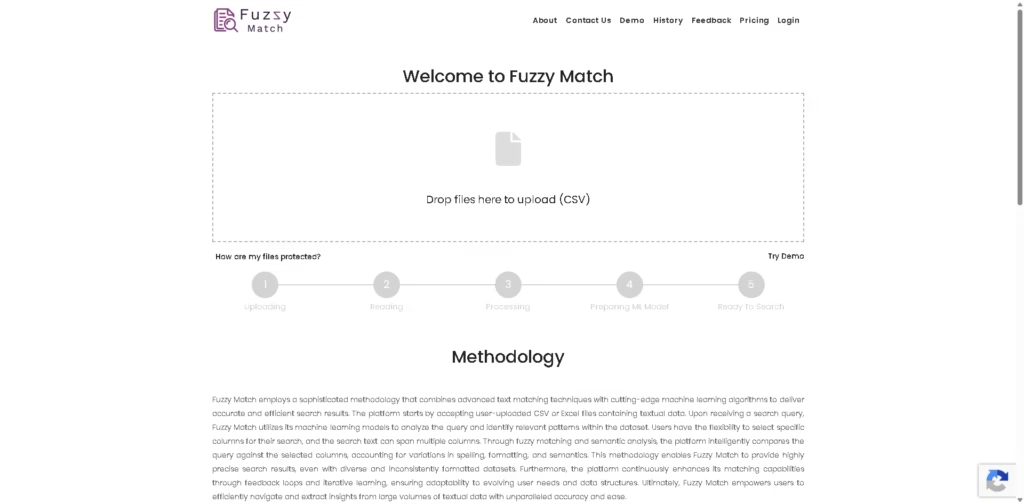
What It Does
Fuzzy Match is a machine-learning-based search and matching platform for finding relevant text across CSV and Excel datasets. It is designed to handle spelling variations, typos, inconsistent formatting, and semantic differences that can make conventional exact-text searches miss relevant records.
Users upload a CSV or Excel file, select the columns to search, and enter a query that can span multiple columns. Fuzzy Match then applies fuzzy matching and semantic analysis to identify relevant records, making it useful for searching noisy or inconsistently formatted textual datasets.
At a Glance
| Field | Details |
|---|---|
| Category | Fuzzy search and data matching |
| Input Formats | CSV, Excel |
| Matching Approach | Machine learning, fuzzy matching, semantic analysis |
| Search Scope | User-selected columns, including multiple columns |
| Primary Strength | Handling typos and inconsistent data |
| Use Cases | Search, data cleansing, information retrieval |
| Feedback Loop | Iterative learning based on feedback |
Key Features
- Matches text despite typographical errors and misspellings.
- Uses machine learning to adapt to input data characteristics.
- Searches across multiple user-selected columns.
- Combines fuzzy matching with semantic analysis.
- Improves recall in large or noisy datasets.
- Supports textual data from CSV and Excel files.
- Uses feedback loops to refine matching capabilities.
Best For
- Finding records when search terms contain spelling mistakes.
- Matching inconsistently formatted textual data across datasets.
- Searching multiple columns with a single query.
- Identifying relevant records in large, noisy text collections.
- Supporting data cleansing and information-retrieval workflows.
Pros & Cons
| Pros | Cons |
| Handles typos, misspellings, and textual variations. | The provided information does not specify supported file-size limits. |
| Supports both CSV and Excel uploads. | Detailed API and integration options are not described. |
| Can search across multiple selected columns. | Accuracy may depend on the characteristics of the uploaded dataset. |
| Uses machine learning rather than relying only on predefined rules. | Advanced matching configuration details are limited in the available documentation. |
| Feedback loops are intended to improve matching behavior. | The platform is primarily focused on textual dataset matching. |
Alternatives & Comparisons
| Alternative | Best For | Key Difference |
| Elasticsearch | Large-scale search applications | Provides a broader search-engine infrastructure with extensive indexing and query capabilities. |
| OpenRefine | Data cleaning and transformation | Focuses more broadly on interactive data cleaning and reconciliation. |
| RapidFuzz | Developer-built fuzzy matching | Provides a programming library rather than a ready-to-use uploaded-file search platform. |
| Splink | Record linkage and entity resolution | Designed specifically for probabilistic record linkage across datasets. |
Fuzzy Match sits between a developer-oriented matching library and a full search-engine platform, emphasizing accessible dataset-based fuzzy search. Choose it when uploading structured files and searching noisy text is the main requirement rather than building a complete search infrastructure.
Frequently Asked Questions
What file formats does Fuzzy Match support?
The platform states that users can upload CSV or Excel files for matching and searching.
Can Fuzzy Match search multiple columns?
Yes. Users can select specific columns, and the search text can span multiple selected columns.
How does Fuzzy Match handle spelling mistakes?
Its fuzzy-matching approach is designed to account for typographical errors, misspellings, and other textual variations.
Does Fuzzy Match use machine learning?
Yes. The platform describes machine-learning models combined with fuzzy matching and semantic analysis.
Is Fuzzy Match suitable for data cleansing?
It can support data-cleansing workflows because its matching approach is designed to identify similar records despite inconsistent textual representations.
Overall Rating
| Category | Score |
| Performance | 8.2/10 |
| Ease of Use | 8.4/10 |
| Feature Set | 7.8/10 |
| Workflow Fit | 8.5/10 |
| Overall | 8.2/10 |
Fuzzy Match is a focused option for searching and matching noisy textual data, particularly when conventional exact matching is insufficient.
Final Verdict
- Best for: Searching CSV or Excel datasets where typos, formatting differences, and semantic variation affect matching.
- Avoid if: You need a complete enterprise search engine or extensive developer integrations.
- Biggest strength: Machine-learning-based matching improves discovery across inconsistent textual datasets.
- Best alternative: OpenRefine is stronger when broader interactive data cleaning and reconciliation are required.