What It Does
DeepSeek R1 is an open-weight reasoning language model built for tasks that benefit from multi-step reasoning, particularly mathematics, coding, and general problem-solving. DeepSeek released the model and several distilled versions, including 1.5B, 7B, 8B, 14B, 32B, and 70B variants, under an MIT license for the R1 series.
The main advantage is flexibility: users can access R1 through DeepSeek’s services and API or deploy the released model weights themselves. For example, a developer could use a distilled R1 model locally for mathematical problem solving, while a larger deployment could use the full 671B-parameter model for more demanding reasoning workloads.
At a Glance
| Field | Details |
|---|---|
| Category | Reasoning language model |
| Architecture | Mixture-of-Experts |
| Total Parameters | 671B |
| Activated Parameters | 37B |
| Context Length | 128K |
| Distilled Variants | 1.5B to 70B |
| License | MIT for the R1 series |
| Primary Strengths | Mathematics, coding, reasoning |
The official repository confirms the 671B total parameters, 37B activated parameters, 128K context length, and six distilled models.
Key Features
- Uses reinforcement learning to improve multi-step reasoning capabilities.
- Provides six distilled models ranging from 1.5B to 70B parameters.
- Supports local deployment using released model weights.
- Offers an MIT-licensed R1 model and weights for commercial use.
- Targets mathematics, coding, and broader reasoning workloads.
- Provides an API for accessing DeepSeek reasoning models.
- Supports distillation and derivative model development under its licensing terms.
Best For
- Solving multi-step mathematics and quantitative reasoning problems.
- Building coding assistants that require deeper problem-solving.
- Experimenting with open-weight reasoning models locally.
- Distilling reasoning capabilities into smaller language models.
- Researching reinforcement-learning-based reasoning systems.
Pros & Cons
| Pros | Cons |
| Open weights and MIT licensing provide substantial deployment flexibility. | The full 671B model requires substantial computing resources for local deployment. |
| Multiple distilled sizes make local experimentation more practical. | Reasoning can be token-intensive and slower than models optimized primarily for fast responses. |
| Strong focus on mathematical, coding, and reasoning workloads. | Model output still requires verification for high-stakes or technically sensitive tasks. |
| Open research materials make the model useful for experimentation. | Smaller distilled versions trade capability for lower resource requirements. |
| API access provides an alternative to self-hosting. | R1 is an older generation model compared with newer reasoning systems available in 2026. |
DeepSeek’s own repository recommends specific generation settings and notes issues observed during development, including repetition and readability problems in R1-Zero. Independent research has also found that R1 can generate substantially more tokens than some competing models on difficult mathematical tasks, which can affect response speed and efficiency.
Alternatives & Comparisons
| Alternative | Best For | Key Difference |
| OpenAI o3 | General-purpose advanced reasoning | More recent proprietary reasoning model with a broader managed ecosystem |
| Gemini 2.5 Pro | Multimodal reasoning and long-context work | Stronger emphasis on multimodal and long-context workflows |
| Qwen3 | Open-weight reasoning and general LLM workloads | Newer open-weight model family with multiple reasoning configurations |
| DeepSeek-V3 | Fast general-purpose AI tasks | Better suited than R1 when deep reasoning is not the primary requirement |
DeepSeek R1 fits users who value open weights, local deployment, and reasoning research rather than simply wanting the newest managed AI assistant. Choose R1 over alternatives when model openness and customization matter more than access to the latest proprietary reasoning features.
Frequently Asked Questions
Is DeepSeek R1 open source?
DeepSeek releases R1 model weights and its repository under the MIT license, although individual distilled models inherit additional licensing considerations from their underlying Qwen or Llama models.
Can DeepSeek R1 run locally?
Yes. DeepSeek released the R1 weights and multiple smaller distilled versions, making local deployment possible, although hardware requirements vary considerably by model size.
Which DeepSeek R1 model is suitable for local use?
The distilled 1.5B, 7B, 8B, 14B, 32B, and 70B versions provide a range of resource requirements. Smaller models are more practical for constrained hardware, while larger models generally offer greater capacity.
Is DeepSeek R1 good for coding and mathematics?
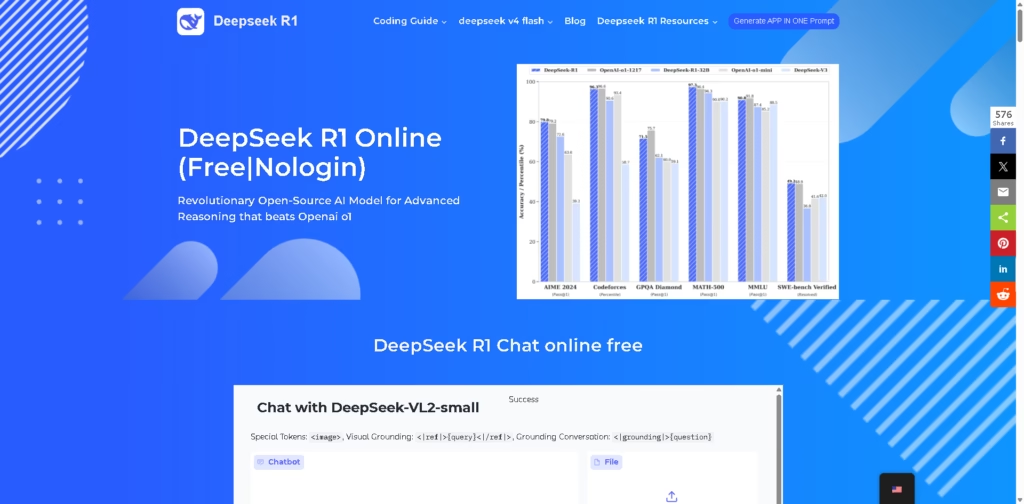
Coding and mathematics are among its primary intended reasoning workloads. DeepSeek’s release documentation specifically reports competitive performance across math, code, and reasoning benchmarks.
Is DeepSeek R1 still the best DeepSeek model to use?
Not necessarily. DeepSeek’s API documentation has since introduced newer models, and the current API maps the older name to a newer reasoning mode. R1 remains relevant for open-weight deployment and research, but users seeking the newest hosted DeepSeek experience should evaluate the current model lineup.
Overall Rating
| Category | Score |
| Performance | 4.5/5 |
| Ease of Use | 3.8/5 |
| Feature Set | 4.5/5 |
| Workflow Fit | 4.3/5 |
| Overall | 4.3/5 |
DeepSeek R1 remains a strong choice for open-weight reasoning and experimentation, but its age and resource demands reduce its appeal for users seeking the newest, fastest managed AI experience.
Final Verdict
- Best for: Developers and researchers who need an open-weight model for advanced reasoning experiments.
- Avoid if: You need the newest multimodal features or the simplest managed AI workflow.
- Biggest strength: Open-weight reasoning with multiple distilled models and permissive R1 licensing.
- Best alternative: Newer reasoning models such as OpenAI o3 for users prioritizing current capabilities.