What It Does
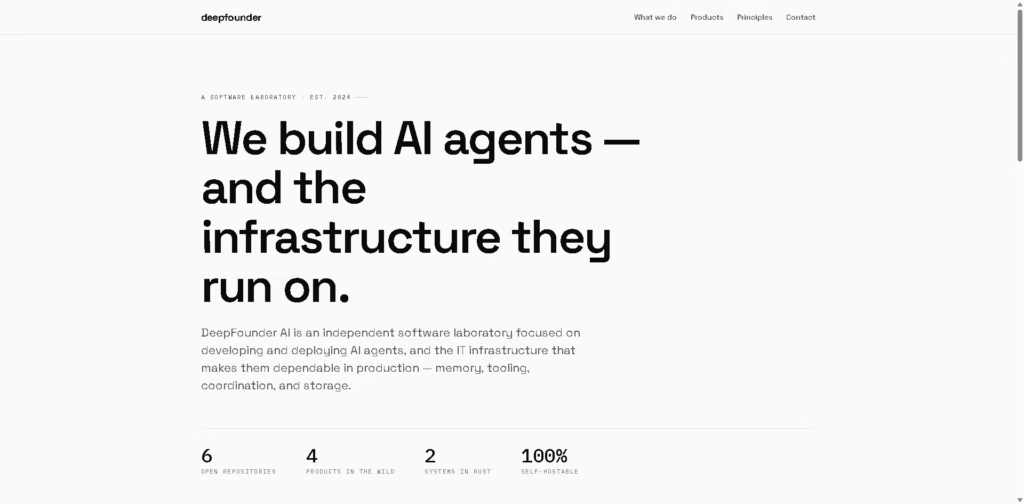
DeepFounder AI is an independent software laboratory that develops AI agents and the infrastructure required to run them in production. Rather than offering a single AI application, it builds open-source, self-hostable systems for persistent memory, agent coordination, issue tracking, and business workflow automation.
The platform targets developers, engineering teams, and organizations that want to deploy AI agents on their own infrastructure instead of relying on managed cloud services. Its products emphasize open interfaces, local deployment, and modular components that integrate into existing workflows.
A typical workflow involves deploying a self-hosted AI agent, connecting it to persistent memory and issue tracking services, and running automated business or knowledge workflows entirely on local hardware or private servers.
At a Glance
| Field | Details |
|---|---|
| Category | AI agent infrastructure platform |
| Primary Use | Self-hosted AI agents and infrastructure |
| Target Users | Developers, engineering teams, enterprises |
| Deployment | Self-hosted |
| Open Source | Yes |
| Languages | Rust, Python, Shell |
| Interfaces | REST, MCP, CLI |
| Primary Strength | Modular infrastructure for production AI agents |
Key Features
- Builds self-hosted AI agents for business workflows.
- Provides persistent memory infrastructure for AI agents.
- Includes AI-oriented issue tracking with SQLite storage.
- Offers REST, MCP, and CLI interfaces across products.
- Supports local deployment on laptops, workstations, and servers.
- Releases core projects as open source.
Best For
- Deploying private AI agents on local infrastructure.
- Building production AI automation workflows.
- Adding persistent memory to AI agents.
- Managing AI-generated tasks through issue tracking.
- Developing open-source AI infrastructure.
Pros & Cons
| Pros | Cons |
|---|---|
| Self-hosted architecture improves data control. | Requires technical deployment knowledge. |
| Open-source ecosystem encourages customization. | Limited turnkey business applications. |
| Consistent REST, MCP, and CLI interfaces. | Smaller ecosystem than established AI platforms. |
| Modular infrastructure supports flexible deployments. | Best suited for technical teams rather than non-technical users. |
Alternatives & Comparisons
| Alternative | Best For | Key Difference |
|---|---|---|
| LangGraph | AI agent orchestration | Focuses on agent workflows rather than self-hosted infrastructure. |
| AutoGen | Multi-agent development | Emphasizes agent collaboration over infrastructure components. |
| CrewAI | Agent workflow automation | Higher-level orchestration with less infrastructure focus. |
| Dify | Self-hosted AI applications | Broader application platform with integrated visual tooling. |
DeepFounder AI occupies the infrastructure layer of the AI agent ecosystem rather than providing a complete no-code platform. It is best suited for teams that prioritize self-hosting, open-source tooling, and production-ready infrastructure.
Frequently Asked Questions
Is DeepFounder AI open source?
Yes. Its products are released as open-source projects with publicly available repositories.
Can DeepFounder AI run without the cloud?
Yes. The platform is designed to be self-hosted on local hardware or private servers.
What programming languages does DeepFounder AI use?
Its projects primarily use Rust, Python, and Shell.
Does DeepFounder AI provide APIs?
Yes. Several products expose REST, MCP, and CLI interfaces.
Is DeepFounder AI suitable for non-technical users?
The platform is primarily intended for developers and technical teams comfortable managing self-hosted infrastructure.
Overall Rating
| Category | Rating |
|---|---|
| Performance | 4.7/5 |
| Ease of Use | 3.9/5 |
| Feature Set | 4.6/5 |
| Workflow Fit | 4.5/5 |
| Overall | 4.4/5 |
DeepFounder AI delivers a strong foundation for organizations building self-hosted AI systems, although its developer-focused approach creates a steeper learning curve than managed AI platforms.
Final Verdict
- Best for: Developers deploying self-hosted AI agents in production environments.
- Avoid if: You need a no-code AI automation platform.
- Biggest strength: Open-source infrastructure with self-hosted deployment and modular agent services.
- Best alternative: LangGraph for agent orchestration or Dify for broader AI application development.