What It Does
Corti is a healthcare AI platform for developers building clinical and operational applications. It provides APIs and agentic infrastructure for medical coding, speech-to-text, text generation, clinical reasoning, documentation, and healthcare workflow automation.
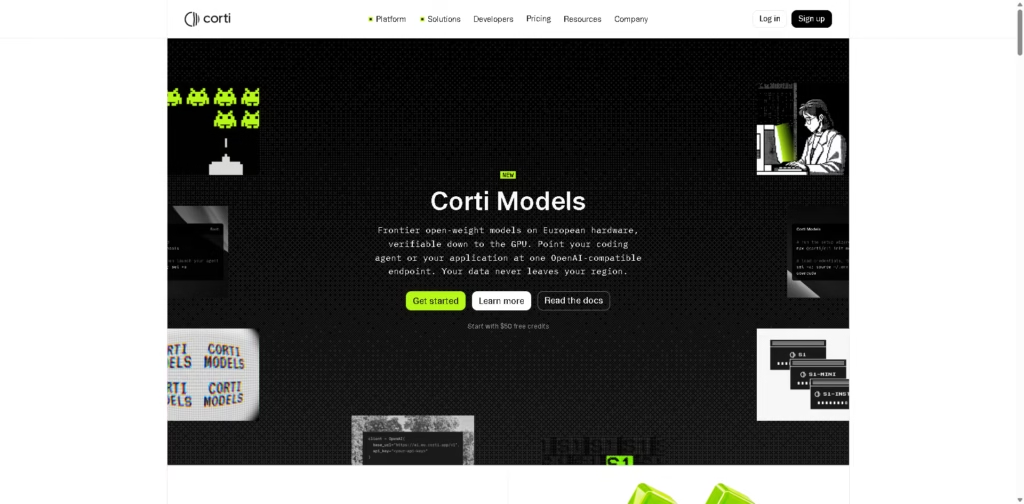
Developers can combine Corti APIs and pre-built agents to create workflows such as ambient clinical documentation, pre-charting, radiology report generation, patient engagement, coding, and prior authorization. The platform uses a shared credit balance across its APIs, while Corti Models provides OpenAI-compatible access to AI coding models hosted on European infrastructure.
Quick Verdict
Best for: Healthcare and life-science developers building AI-powered clinical applications.
Skip if: You need a general-purpose AI platform rather than healthcare-specific APIs and workflows.
Key Advantage: Healthcare-native APIs and agents across clinical and administrative workflows.
Top Alternative: Healthcare-focused AI platforms with developer APIs and clinical workflow capabilities.
At a Glance
| Feature | Details |
|---|---|
| Category | Healthcare AI / Developer Platform |
| Pricing Model | Usage-Based |
| Free Tier | $50 Free Credits |
| Platform | Web / API |
| API | Yes |
| Primary Strength | Healthcare AI APIs and agents |
| Deployment Options | Hosted and sovereign cloud |
Pricing & Plans
Corti uses usage-based pricing through a shared credit balance across its APIs.
- Free Credits: $50 in free credits with no upfront commitment.
- Speech to Text: $0.0065 per minute.
- Medical Coding: $4 per million input tokens and $16 per million output tokens.
- Agents: $4 per million input tokens and $16 per million output tokens.
- Text Generation: $4 per million input tokens and $16 per million output tokens.
- Corti S1: $2 per million input tokens, $0.20 per million cached input tokens, and $8 per million output tokens.
- Corti S1 Mini: $1 per million input tokens, $0.10 per million cached input tokens, and $4 per million output tokens.
- Acceleration Pack: $1,000/month for 1,000 credits, five development hours per month, and architecture review.
- Corti Advance: Custom rolling monthly commitment with embedded engineering support and no minimum term.
- Enterprise: Custom credit bundles, higher concurrency, custom-trained models, sovereign cloud deployments, and priority throughput.
- Credit Validity: Credits are valid for one year.
Note: Prices and plan limits may change. Check the official website for current pricing.
Key Features
- Provides medical speech-to-text through a dedicated API.
- Generates structured clinical documentation from transcripts and healthcare data.
- Returns medical coding predictions with supporting evidence and audit trails.
- Provides 20+ pre-built AI agents for clinical and operational workflows.
- Offers EU-hosted coding models through an OpenAI-compatible endpoint.
- Supports healthcare workflows including documentation, coding, triage, and patient engagement.
Best For
- Healthcare startups building clinical AI applications.
- Developers creating ambient documentation and medical transcription tools.
- Teams automating medical coding and revenue-cycle workflows.
- Healthtech products requiring clinical text generation APIs.
- Organizations building custom healthcare agents and workflow automation.
Pros & Cons
Pros
- Broad healthcare-specific API and agent coverage.
- Shared credits can be used across multiple Corti capabilities.
- Provides pre-built agents for clinical and administrative workflows.
- Offers $50 in free credits for initial development.
- Includes EU-hosted AI coding models and sovereign infrastructure options.
Cons
- Usage-based pricing can make total costs dependent on application volume.
- Advanced engineering and enterprise capabilities require higher-cost or custom arrangements.
- The platform is specialized for healthcare rather than general-purpose application development.
Alternatives & Comparisons
| Alternative | Best For | Key Difference vs. Corti |
|---|---|---|
| Azure AI Health Bot | Healthcare conversational applications | Provides Microsoft’s healthcare-oriented conversational tooling and cloud ecosystem. |
| Google Cloud Healthcare API | Healthcare data and application infrastructure | Focuses heavily on healthcare data interoperability and cloud infrastructure. |
| AWS HealthScribe | Clinical documentation applications | Provides AWS-based capabilities for generating clinical documentation from conversations. |
Corti is positioned as a healthcare-native developer platform combining APIs, pre-built agents, medical coding, speech recognition, and clinical text generation. It is particularly relevant when a product team wants several healthcare AI capabilities available through a shared platform and credit balance.
Frequently Asked Questions
What is Corti?
Corti is a healthcare AI platform that provides APIs, AI agents, and infrastructure for building clinical and operational healthcare applications.
Does Corti provide an API?
Yes. Corti provides APIs for capabilities including speech-to-text, medical coding, and text generation, along with an agentic framework.
How does Corti pricing work?
Corti primarily uses usage-based credits. Different APIs consume credits according to factors such as audio minutes or input and output token usage.
Does Corti offer free credits?
Yes. The supplied pricing information states that new users can explore Corti APIs with $50 of free credits.
What can developers build with Corti?
Examples include ambient scribes, pre-charting tools, medical coding applications, radiology report generation, patient engagement systems, clinical decision-support workflows, and revenue-cycle automation.
ToolsPedia Rating
Editorial assessment based on supplied product information, not hands-on testing.
- Performance & Speed: 4.6/5.0
- Ease of Setup: 4.2/5.0
- Feature Depth: 4.8/5.0
- Value for Price: 4.2/5.0
- ToolsPedia Score: 4.5/5.0
Final Thoughts
Corti provides a broad developer stack for teams building healthcare AI products, combining medical APIs, pre-built agents, clinical documentation capabilities, coding workflows, and specialized models. Its usage-based credit system and free starting credits make experimentation possible, while enterprise and sovereign deployment options address more complex production requirements.
For developers evaluating Corti, the main consideration is whether their application needs healthcare-specific infrastructure rather than a general AI API. The platform is most relevant when clinical workflows, medical data processing, and healthcare-focused AI capabilities are central to the product.