What It Does
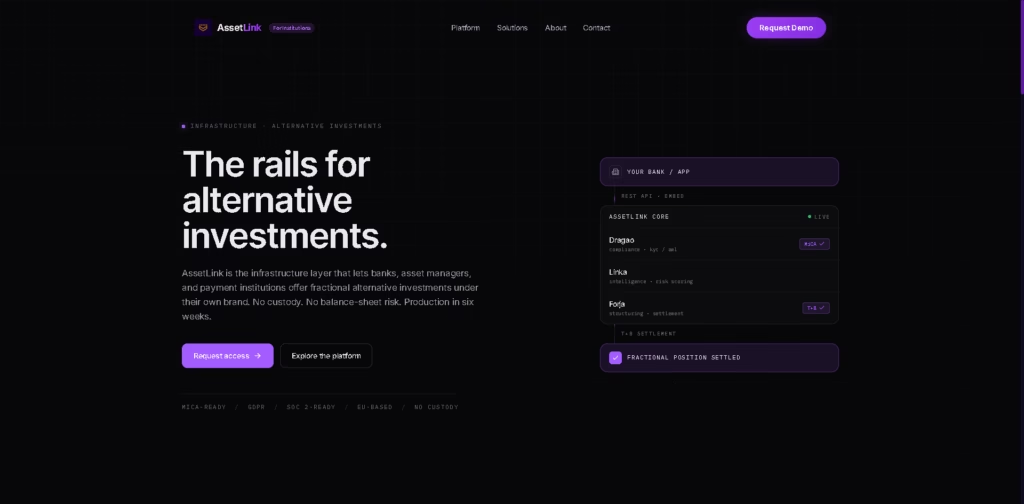
AssetLink is an alternative investment infrastructure platform designed for banks, asset managers, and payment institutions. It provides the technology needed to offer fractional alternative investments under an institution’s own brand, with API and white-label deployment options.
The platform combines investment intelligence, asset verification, automated KYC/AML compliance, fractional asset structuring, and settlement through a single infrastructure layer. It says institutions can integrate the platform into their existing applications and launch production workflows in around six weeks.
Quick Verdict
- Best for: Financial institutions offering fractional alternative investments
- Skip if: You need a consumer-facing investment app or general investment software
- Key Advantage: White-label infrastructure for fractional investments
- Top Alternative: Securitize
At a Glance
| Feature | Details |
|---|---|
| Category | Alternative Investment Infrastructure |
| Pricing Model | Custom / Enterprise |
| Free Tier | No |
| Platform | Web, API, White-Label |
| API | Yes |
| Primary Strength | Fractional investment infrastructure |
| Deployment | API or white-label portal |
Pricing & Plans
AssetLink does not publish standard subscription pricing on the supplied website content. Instead, it directs financial institutions to request access or speak with its team.
The platform states that its revenue model includes:
- Setup fee
- Annual license
- Revenue share
It also positions deployment around an approximately six-week integration period through either its API or white-label portal.
Note: Prices and plan limits may change. Check the official website for current pricing.
Key Features
- Provides white-label and headless API deployment for financial institutions.
- Supports fractional alternative investment products under an institution’s own brand.
- Automates KYC/AML compliance across 50+ jurisdictions.
- Provides investment intelligence, analytics, and risk scoring.
- Verifies asset ownership, value, legal status, and condition.
- Handles fractional unit creation, clearing, and settlement.
- Supports automated NAV, distributions, cap tables, and investor reporting.
- Offers T+0 settlement and real-time reconciliation capabilities.
Best For
- Banks embedding alternative investments into existing banking applications.
- Asset managers launching and managing fractional investment products.
- Payment institutions adding investment products to payment workflows.
- Institutions seeking white-label investment infrastructure.
- Teams needing integrated compliance and settlement workflows.
Pros & Cons
Pros
- Designed specifically for institutional alternative investment infrastructure.
- Supports both API-based and white-label deployment.
- Combines compliance, asset verification, intelligence, and settlement.
- Provides fractional investment and T+0 settlement capabilities.
- Built around institutional security, audit trails, and compliance requirements.
Cons
- Pricing is not publicly listed.
- Primarily designed for financial institutions rather than individual investors.
- Several performance figures are vendor claims and are not independently verified here.
- Full implementation may require institutional integration and compliance work.
Alternatives & Comparisons
| Alternative | Best For | Key Difference vs. AssetLink |
|---|---|---|
| Securitize | Institutional digital securities | Broader focus on tokenized securities and capital markets |
| Polymesh | Regulated asset tokenization | Blockchain infrastructure with a stronger securities-tokenization focus |
| Tokeny | Institutional asset tokenization | Focuses on token issuance, compliance, and transfer infrastructure |
AssetLink is positioned as a broader infrastructure layer combining alternative investment workflows, compliance, asset verification, and settlement. Choose it when you want these capabilities delivered behind your existing financial brand rather than building the infrastructure yourself.
Frequently Asked Questions
What is AssetLink?
It is an infrastructure platform that enables financial institutions to offer fractional alternative investments under their own brand.
Who is AssetLink designed for?
The platform is primarily designed for banks, asset managers, and payment institutions.
Does AssetLink provide an API?
Yes. AssetLink describes a headless API alongside a white-label portal for institutional integrations.
How long does AssetLink integration take?
AssetLink states that its API or white-label deployment can reach production in approximately six weeks.
Does AssetLink handle compliance?
Yes. AssetLink describes a headless API alongside a white-label portal for institutional integrations.
How long does AssetLink integration take?
AssetLink states that its API or white-label deployment can reach production in approximately six weeks.
Does AssetLink handle compliance?
Yes. Its Dragao engine is designed for KYC/AML verification, screening, and continuous transaction monitoring across 50+ jurisdictions, according to the supplied information.
Does AssetLink support fractional investments?
Yes. AssetLink is specifically designed to help institutions offer fractional alternative investments and describes fractional unit creation and settlement as part of its infrastructure.
ToolsPedia Rating
- Performance & Speed: 4.3/5.0
- Ease of Setup: 4.0/5.0
- Feature Depth: 4.7/5.0
- Value for Price: 4.0/5.0
- ToolsPedia Score: 4.3/5.0
Final Thoughts
AssetLink offers a specialized infrastructure stack for institutions that want to bring fractional alternative investments into existing banking, asset-management, or payment platforms. Its strongest differentiator is the combination of white-label deployment, compliance, asset verification, investment intelligence, and settlement within one institutional workflow.
The platform is less relevant for individual investors or smaller teams looking for ready-to-use investment software, but it could be a strong fit for financial institutions that want to build alternative investment capabilities without developing every infrastructure layer internally.